
Part One 2. The Place We All Stand: Everyone Stands within the Biblical Worldview When I say that we all stand within the biblical worldview, I know that I have some explaining to do. I want to say right away that I am not claiming that we all acknowledge this. In fact, the Bible says we act to suppress the knowledge of God. But it protrudes here and there since it must. For God must be already there in order …
Category: Articles

This is the working document I used for my talk at the Bible and Beer Consortium in Fort Worth last week. As you will discover if you watch the presentation itself, I departed from the notes quite a bit (which is not unusual for me). Intro. Let me begin with a few lines from T. S. Eliot: “Endless invention, endless experiment, Brings knowledge of motion, but not of stillness; Knowledge of speech, but not of silence; Knowledge of words, …

These are some notes i made on one of Jonathan Edwards’ most famous sermons. Edwards got to the heart through the mind, as all real preaching does. I re-post this because I was reminded of the sermon yesterday by a preacher I heard. Following the standard Puritan model of composition (outlined by William Perkins) Edwards gives a brief exposition of his text: Matt. 16:17. He then explains the doctrinal content of the passage, before closing with application. Exposition The knowledge …
Part One The second argument, that there are covenantal elements in the Creation narratives, is somewhat dependent upon the first for its advocacy. Nobody denies that there is a repetition of parts of the Creation mandate in Genesis 9. But such a repetition was necessary seeing that God had just wiped out every living thing from the map. That necessity doesn’t extend however, to requiring a covenant given to Adam in the Garden. And we are not justified in drawing …
More material from the “big book”. There need not be much dissension from the view that Genesis 6:18 may refer to a previous understanding of covenant on Noah’s part.[1] It could equally mean that the covenant was “in God’s mind” before the waters came and He chose out Noah.[2] In either case the interpretation stresses the gracious (hen) movement of God towards Noah (6:8). But could it, indeed, should it, be construed as a reference to a “Creation covenant,” instituted …
Part Nine In the last installment of this series we were looking at a motto which is often misused by the Christian community, and which could mislead young people if not carefully explained. That motto was “All truth is God’s truth.” This time round I want to take a look at another slogan; a slogan which should not be adopted by Bible believers, even though some prominent and respected authorities use it. The phrase I have in mind is this: …
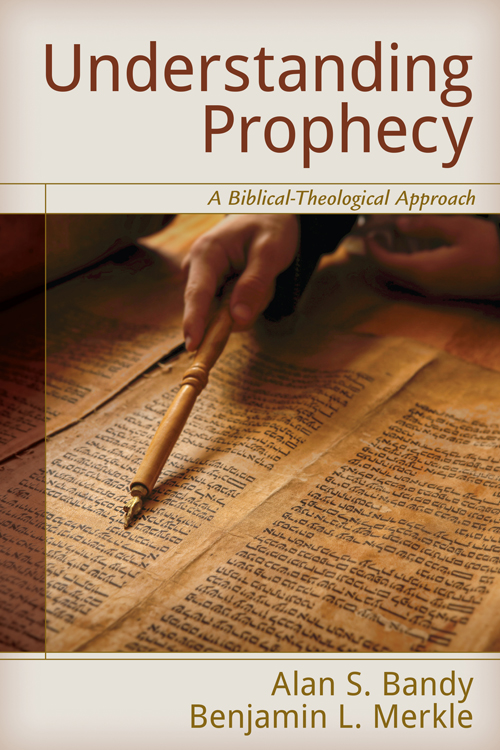
Review of Understanding Prophecy: A Biblical-Theological Approach, by Alan S. Bandy and Benjamin L. Merkle, Grand Rapids: Kregel, 2015, 264 pages, paperback N.B. This review is from the perspective of someone who is less than an enthusiastic supporter of symbolical cum typological interpretations of the Bible, so it will be mainly critical. However, for those in-tune with the approach of the writers, the book can be recommended as a good explication of the redemptive-historical method. This new book on prophecy …
Part Eight Last time I asked whether the facts speak for themselves. My answer was that they do not, they are freighted with interpretations, whether right or wrong. In Part Seven I called attention to the temptation of attaching ourselves to slogans and ideas from the world. Before proceeding along the lines I started with in the last post, I want first to take two common but deadly slogans which Christians use and look at them, for though they sound …
After a ridiculously long delay, I have started to finish off my series on the Parameters of Meaning beginning with this one on Typology. I believe these guidelines will help Bible students avoid many pitfalls in interpretation by setting limits on what constitutes legitimate hermeneutics. For those of you interested here are the previous installments: Parameters of Meaning – Introduction Parameters of Meaning – Rule 1 Parameters of Meaning – Rule 2 Parameters of Meaning – Rule 3 Parameters of …

Part Three Speech-Act Theory and Biblical Interpretation On a more positive note overall is the matter of whether language is merely descriptive or whether it can be said to actually do something. This gets us into the subject of language as “speech-acts.” This view has been defined as follows: Speech-act theory is a set of pragmatically based principles that were developed at the edge of philosophy and linguistics. The major assumption is that language is not so much concerned with saying …


