A Superficial Case Many dispensationalists cite Romans 9:4 as proof that the covenants are only given to Israel, with the Church having no part in them. The verse reads: who are Israelites, to whom pertain the adoption, the glory, the covenants, the giving of the law, the service of God, and the promises… I think there is a superficial case for using this verse to fend off those, like the present writer, who believe that the Church is party to the New covenant. Reading …
Blog Posts
PART FOUR In starting this installment let me be clear about the purpose of this series. It is not to deny that the NT writers cite the OT, or that they augment OT revelation. The issue here is about whether NT writers interpret OT passages as types and shadows of Jesus and the Church. It’s about whether they believed most of the OT covenants and prophecies were fulfilled at the first coming in some spiritualized way, and if so, where …
PART THREE Those who tell us that we must interpret the OT by the NT point us to NT texts which they insist prove their position. I want to take a look at these texts and ask whether they are being interpreted accurately. Because if they are not being interpreted correctly the whole procedure will start to appear like a question-begging exercise for the purpose of protecting a preferred view of the Bible’s teaching. Romans 15:4: For whatever things were …
I find myself involved in too many things to focus on new posts at the moment. Hopefully, I’ll have something new very soon. In the meantime, here’s something from my old dissertation you may find useful for reflection. Even a superficial reading of John’s opening verses sets before the reader the absoluteness of his Logos concept as communicated by the Holy Spirit. To summarize, the Logos is part of the Godhead (vv1-2); and as a member of the Godhead He …
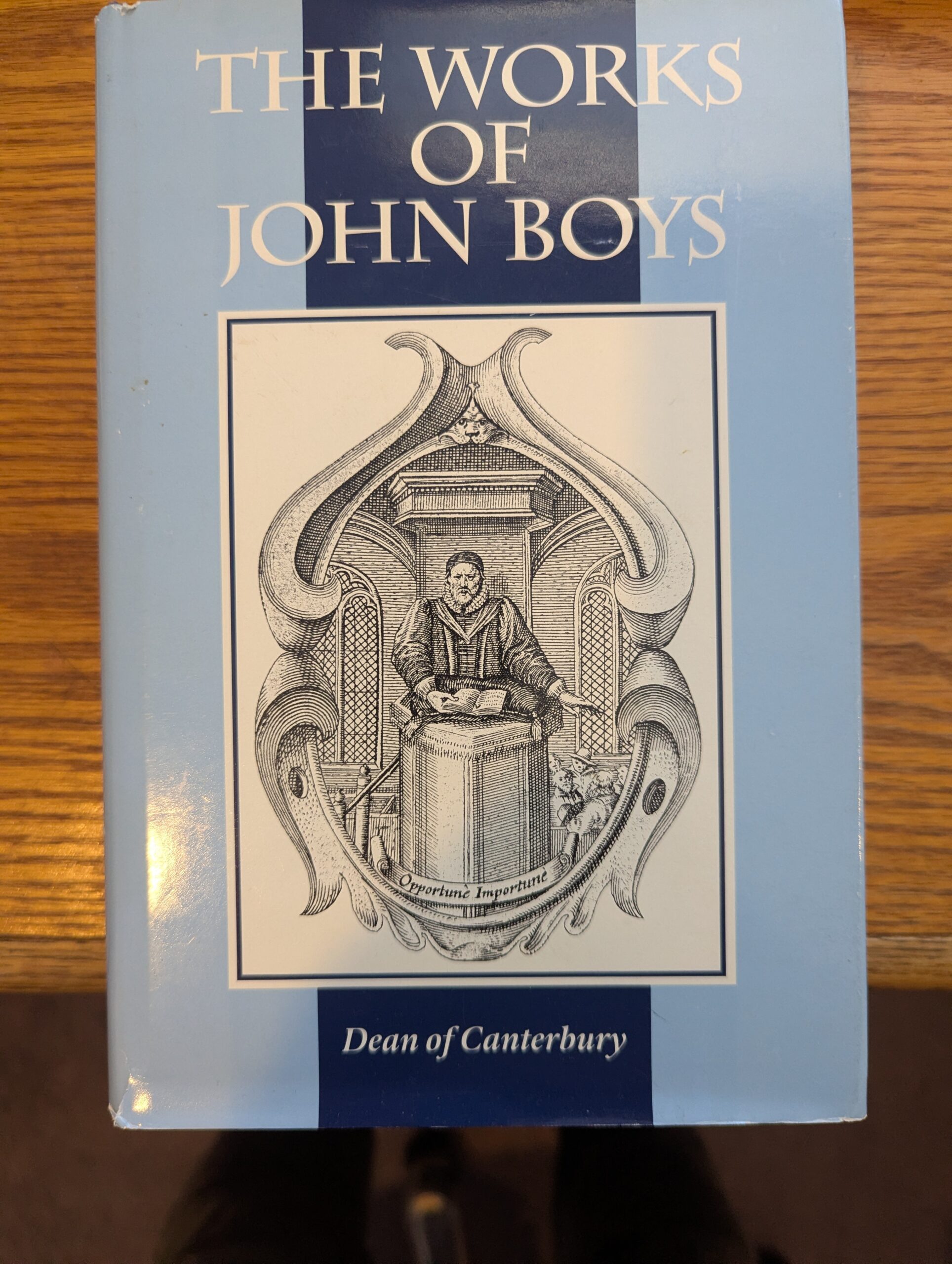
PART TEN – Puritan Books Evaluated (Pt. 10) – The Works of Hugh Binning It is a bit of a stretch to call John Boys (1571-1625) a Puritan. He was an Anglican cleric who was Dean of Canterbury Cathedral and a translator of the Authrized (King James) Version of the Bible of 1611. He was certainly evangelical in his sympathies and was held in high esteem by his contemporaries. This volume was reissued by Soli Deo Gloria in the late …
PART TWO The doctrine of the sufficiency of Scripture is probably the most abused of all the doctrines of Biblical Christianity. As the Word of God, the only Word from outside the human realm, it ought to be cherished, adhered to and followed. But even within the borders of so-called “Christendom” the Bible is hardly allowed a position of absolute authority. Seldom is it permitted the power of veto, particularly when, in our narcissitistic society, its truths and precepts go …
PART ONE Early Christians Could Not Interpret The OT with the NT Because They Did Not Possess A Full NT It is all very well sitting back in our plush chairs with our laptops or tablets resting against our knees while sipping a latte and carelessly typing out the line, “the OT must be understood through the NT.” It’s easy to do. But a reality check is in order here. In our 21st Century world, where so many things are …
“Only Our Interpretations of the NT are Permitted” Among those who like to criticize Dispensational Premillennialism one encounters a popular mantra: It is that the OT needs to be interpreted by the NT. The logic appears straightforward enough. Since the NT introduces Jesus Christ, and the Apostolic writings unpack the doctrine of Christ, one must go back to the OT with the NT teaching in hand so as to unlock God’s meaning. This reasoning seems so self-eveident to its promoters …
I know I’m in danger of confusing everyone, but I want to announce that not only have I completed The Oaths of God: An Introduction to Biblical Covenantalism, but I am also basically done with the first draft of Deciphering Covenant Theology: A Critique. I thought you might like a look at the Table of Contents and maybe pray for the book. I realize that even though I’m a nobody, a book such as this will tick off covenant theologians. …
I have completed the entire first draft of The Oaths of God, which is a more compact (around 300 pages) edition of the two big volumes of The Words of the Covenant. Lord willing, we can get to publishing soon. THE OATHS OF GOD: An Introduction to Biblical Covenantalism Preface TABLE OF CONTENTS: Introduction: What’s so Remarkable About God’s Covenants? 1. What I Mean by “Biblical Covenantalism” 2. Before the Covenants 3. Why God’s Covenants Are More Important than Dispensations 4. The Noahic Covenant …