Part One The Main Verses In this installment all I want to do is to set down the main verses which are used in discussions about the rapture. Let me make it clear that this is not to say that many other passages must be considered so as to understand the doctrine. As I will be at pains to show, the rapture is not a teaching that can be established by simply comparing proof-texts. The doctrine excites many passions and …
Category: Theology

I had been intending to write about the removal of the Church (the rapture) for quite a while now. What galvanized me to do so now was a couple of entries by Ben Witherington and Roger Olson about the pretribulational rapture. These men, (like them or not), do not usually write poorly, but their articles attacking the concept of the pretribulational rapture are pretty lame ducks, rehashing the same old populist presentations of Dispensationalism by sniping at Clarence Larkin’s charts, …
Part Two Jesus as the Word Even though the teaching of the “Word” or “Logos” appears prominently and explicitly in the prologue to John’s Gospel, the theme runs through the whole of the Gospel.[1] John stresses the words of Jesus as having special significance as words: Rhemata is used nine times for His words (5:47; 6:63, 68; 8:20;10:21; 12:47, 48; 14:10; 15:7), and three times for the words of God spoken by Jesus (3:34; 8:47; 17:8). John employs logos three …
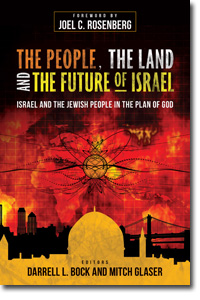
Review of The People, The Land, and The Future of Israel, edited by Darrell L. Bock and Mitch Glaser, Grand Rapids: Kregel Publications, 2014, 349 pages. The book under review is the result of a conference that was held in New York in support of the special place of Israel in the Scriptures. Seventeen contributors put forth various articles under the headings of New Testament, Old Testament, Hermeneutics, Theology & Church History, and Practical Theology. A Forward is provided by …
With your indulgence, I’m going to repost a set of three studies on Jesus Christ as the Logos of God. They are a bit long, but hopefully useful. It may sound somewhat unseemly for anyone to refer to the Lord Jesus Christ as “the Logos of God,” but to conceive of Him (momentarily) in this abstract way opens up new lines of inquiry that are harder to see under His personal name. And, after all, the Apostle John was …
This is a note from a book I am trying to write. We must too be aware that a prophet foretells. The term “prophet” (nabi) basically means “mouthpiece” or “spokesman” (Cf. Exod. 7:1-2 with 4:16; Deut. 18:17-18). They were preachers, proclaiming the words of God to their contemporaries. But in the Bible the most prominent function of a prophet was to proclaim God’s word about future events (see e.g., Jer. 1:7-16; Amos 7:7-9, 14-17; 1 Ki. 1:22). As we shall …
Part Five C. Phinehas (‘Priestly’) Since I have treated this covenant elsewhere in some detail I shall just briefly rehearse the salient facts. Owing to the zeal of Phinehas, Aaron’s grandson, a devastating plague was stopped and God’s wrath appeased (Num. 25: ). Although Phinehas could have had no idea what God would do next, his honoring of God’s holiness elicited a quite un-looked-for covenant between God and Phinehas’s offspring (Num. 25:13; Psa. 106:28-31). This covenant stands behind the promise …
Part Four As I have said, at the most rudimentary level covenants are for the purpose of reinforcing plain speech about specific momentous things. They do this formally in the terms of the covenant and its obligations upon specified parties. God holds human beings to the very words of their covenant oaths (Jer. 34:18; Ezek. 17:15c). The Bible also indicates that God “keeps covenant” (Deut. 7:9; Neh. 9:32; Dan. 9:4). We would expect no less from Him who cannot lie …
{This is part of a chapter by chapter critique of this book at SharperIron] Before foraying into the New Testament, where he seems to think he will find justification for his views, Matthew Vines attempts to deal with “The Abominations of Leviticus.” He does not deal with the relevant texts by doing contextual exegesis or theological formulation; instead he takes a more indirect route around Leviticus 18:22 and 20:13. Basically his approach is to relativize the Old Testament law by …
Part Three If it were up to us… If the Lord had relied upon men to fulfill their duties before fulfilling His oaths there would be no reason at all to make covenants in the first place. He was on the safest ground possible, and could have promised the universe without having to concern Himself about fulfilling anything. We all fail. Christians know that unless God is faithful to stand behind His promise in the Gospel, we are all done …
