
Part One The Main Verses In this installment all I want to do is to set down the main verses which are used in discussions about the rapture. Let me make it clear that this is not to say that many other passages must be considered so as to understand the doctrine. As I will be at pains to show, the rapture is not a teaching that can be established by simply comparing proof-texts. The doctrine excites many passions and …
Category: Articles
Part Two Jesus as the Word Even though the teaching of the “Word” or “Logos” appears prominently and explicitly in the prologue to John’s Gospel, the theme runs through the whole of the Gospel.[1] John stresses the words of Jesus as having special significance as words: Rhemata is used nine times for His words (5:47; 6:63, 68; 8:20;10:21; 12:47, 48; 14:10; 15:7), and three times for the words of God spoken by Jesus (3:34; 8:47; 17:8). John employs logos three …
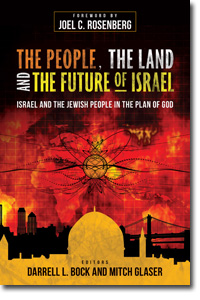
Review of The People, The Land, and The Future of Israel, edited by Darrell L. Bock and Mitch Glaser, Grand Rapids: Kregel Publications, 2014, 349 pages. The book under review is the result of a conference that was held in New York in support of the special place of Israel in the Scriptures. Seventeen contributors put forth various articles under the headings of New Testament, Old Testament, Hermeneutics, Theology & Church History, and Practical Theology. A Forward is provided by …
With your indulgence, I’m going to repost a set of three studies on Jesus Christ as the Logos of God. They are a bit long, but hopefully useful. It may sound somewhat unseemly for anyone to refer to the Lord Jesus Christ as “the Logos of God,” but to conceive of Him (momentarily) in this abstract way opens up new lines of inquiry that are harder to see under His personal name. And, after all, the Apostle John was …
Part One 3. Allegorical Interpretation continued. But what we must keep in mind is that allegorical interpretation was not foreign to Jewish understanding of their Scriptures in the first century. Maier can say, “Jewish interpreters of the first century were convinced that the Holy Scriptures contained more than what the sensus literalis offered.” – Gerhard Maier, Biblical Hermeneutics, 68. Thus, we should not yield to the naïve temptation to think that the Jews held to single-sense literal hermeneutics. So what did …
PART FIVE Natural Theology and Methodological Naturalism How can scientific naturalism be a child of Christian theology? That is a good question. One would think that such a methodology, disposed as it is to serve the worldviews of materialists and atheists, and presented by them as indispensable to good science, would have been contrived by them, but such is not the case. In fact Cornelius Hunter contends that, What we need…is a clear understanding of what naturalism is. Naturalism’s adherents …
This is a note from a book I am trying to write. We must too be aware that a prophet foretells. The term “prophet” (nabi) basically means “mouthpiece” or “spokesman” (Cf. Exod. 7:1-2 with 4:16; Deut. 18:17-18). They were preachers, proclaiming the words of God to their contemporaries. But in the Bible the most prominent function of a prophet was to proclaim God’s word about future events (see e.g., Jer. 1:7-16; Amos 7:7-9, 14-17; 1 Ki. 1:22). As we shall …
This is one which came out a couple of years back. Thought it deserved a rerun: When one is associating a belief with the text of Scripture it is never wise to choose texts from obscure, debated or overly figurative portions of the Bible. Why go to a vision of Zechariah when you can go to an epistle of Paul for the same doctrine? When tying a doctrine concerning the Church to Scripture we find good men like F. Turretin …
Part Four The Definition of Science In the course of writing about the idea of science in his Systematic Theology, Reformed writer Michael Horton notes that “Britain’s Royal Society was founded by Puritans.” – The Christian Faith, 339 n.48 The Puritans saw no clash, either ontological or methodological, in pursuing science as a response to God’s revelation. The fact that God created the world and created man in His image meant that to find out what God had done was …
Part Five C. Phinehas (‘Priestly’) Since I have treated this covenant elsewhere in some detail I shall just briefly rehearse the salient facts. Owing to the zeal of Phinehas, Aaron’s grandson, a devastating plague was stopped and God’s wrath appeased (Num. 25: ). Although Phinehas could have had no idea what God would do next, his honoring of God’s holiness elicited a quite un-looked-for covenant between God and Phinehas’s offspring (Num. 25:13; Psa. 106:28-31). This covenant stands behind the promise …
