Creation and Communication Without the creation of Adam and Eve the whole sequence of days which preceded them would be a rather futile exercise. If the sequence found in the Bible’s very first chapter is to signify anything as a sequence, it had to be an actual seven day sequence. Otherwise it is hard to see why ordinal numbers would be used to describe the process. Also, without observers capable of recognizing and wondering after God’s wonders around them, God’s …
Category: Biblical Studies
Here are the other short videos on major interpretative topics: …

“Rule” 7 Parameters of Meaning – Rule 8: Never ground a teaching on disputed, ambiguous or debated texts (e.g. Matt. 10:23). At best they may serve to support a given position. Doctrines should come from the strongest possible connections between text and teaching. When one is setting forth a proposition, the cogency of it and the logical extent to which it may be propounded depends much on the quality of its substantiation. The gauge of “quality” would include things such …
Part One If we turn to Covenant theology’s own explanations of their system we find a curious dualism of frankness and subterfuge. I do not use “frankness” in the ethical sense, just in the sense that there is sometimes a willingness to face the text and deal with what it actually says. Likewise, by “subterfuge” I am not saying there is an unethical motive in these men, but that they almost instinctively avoid the clear implications of passages which undermine …
I think it is fair to say that the whole impetus for the covenants of redemption, works and grace in the Reformed Confessions stems from the assumption that the Old Testament must be read through the lens of the extra light of the New. If that assumption is flawed, as I believe it certainly is, then the whole project is in serious trouble. The release of the Westminster Confession of 1647, although it was preceded by over a century of …
Part One The second argument, that there are covenantal elements in the Creation narratives, is somewhat dependent upon the first for its advocacy. Nobody denies that there is a repetition of parts of the Creation mandate in Genesis 9. But such a repetition was necessary seeing that God had just wiped out every living thing from the map. That necessity doesn’t extend however, to requiring a covenant given to Adam in the Garden. And we are not justified in drawing …
More material from the “big book”. There need not be much dissension from the view that Genesis 6:18 may refer to a previous understanding of covenant on Noah’s part.[1] It could equally mean that the covenant was “in God’s mind” before the waters came and He chose out Noah.[2] In either case the interpretation stresses the gracious (hen) movement of God towards Noah (6:8). But could it, indeed, should it, be construed as a reference to a “Creation covenant,” instituted …
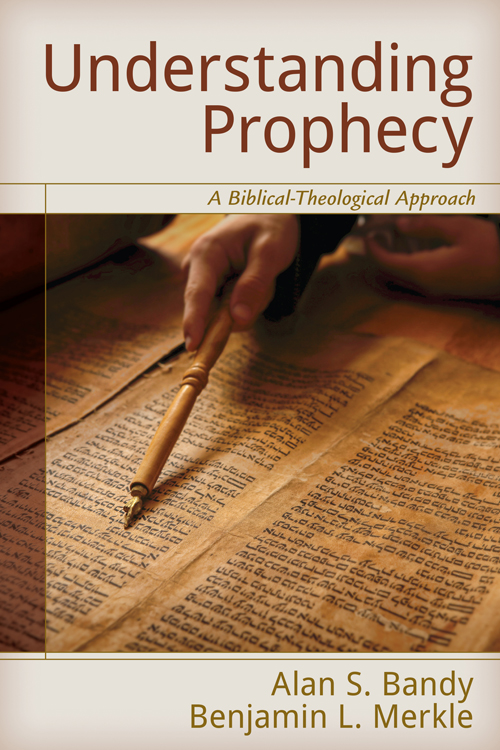
Review of Understanding Prophecy: A Biblical-Theological Approach, by Alan S. Bandy and Benjamin L. Merkle, Grand Rapids: Kregel, 2015, 264 pages, paperback N.B. This review is from the perspective of someone who is less than an enthusiastic supporter of symbolical cum typological interpretations of the Bible, so it will be mainly critical. However, for those in-tune with the approach of the writers, the book can be recommended as a good explication of the redemptive-historical method. This new book on prophecy …
The scenes from the story of Cain and Abel, up until the “sons of God”, and the global Flood cover a period of perhaps two thousand years. Genesis 4 properly belongs with the previous three chapters. It begins and ends with namings; the naming of Cain (“acquired”, or “brought forth”), and the naming of Seth (“granted [substitute]”), and then Seth’s naming of Enosh (“frailty”). In the beginning of this chapter we find two brothers, Cain and Abel, who are worshipping …
This question came to me via Spirit & Truth, a website I am privileged to have a part in. Question: Thanks very much for your TELOS series of Biblical Covenantalism. I stumbled upon this at just the time I needed it – and therefore believe God led me to your sight. The minister of our church is staunchly amillenialist, and I am involved in discussions with him. The question he will get me on, unless you can provide me with …